09.29.15

Progress Report #6

This report extends the insights described in Report #5 and shows that several common conclusions about LENR are wrong. These errors have handicapped efforts to achieve reproducibility and have lead several theories in the wrong direction.

PROGRESS-REPORT-6 Additional behavior of pure PdD (1.3Mb)

Temperature plays a significant role in affecting the amount of power produced by LENR. The activation energy for power production is very similar to the activation energy for diffusion of D in PdD. This behavior is consistent with my theory in which temperature is described as helping D reach the NAE by diffusion through the surrounding lattice.

Comments are welcome.

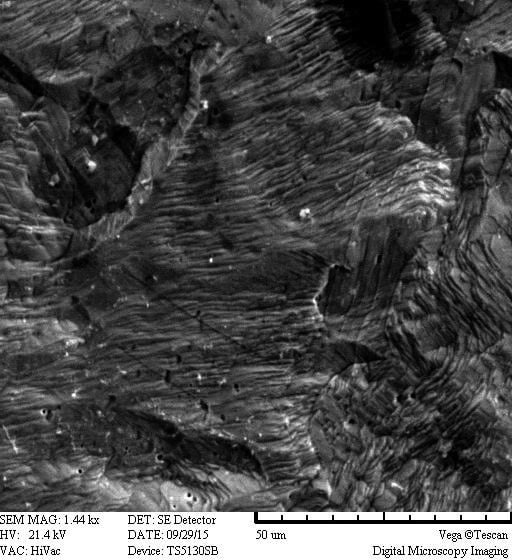
Figure 9 from Progress Report #6 showing surface of the Pd cathode after the study.

Figure 9 from Progress Report #6 showing surface of the Pd cathode after the study.

Figure 10 from Progress Report #6 shows surface of Pd before the study.

Figure 10 from Progress Report #6 shows surface of Pd before the study.

Read more from PROGRESS-REPORT-6 (1.3Mb)

See also:

Progress Report #6

Progress Report #5

Progress Report #4

Progress Report #3

Progress Report #2

Progress Report #1

09.14.15

Progress Report #5

Here is the latest progress report. Shown are some important behaviors that have been misinterpreted in the past, so a careful reading would be useful. This report will appear with the other Reports on www.LENRexplained.com. Because these are quickly written informal reports, some typos and other errors are to be expected. Comments and suggestions are welcome.

PROGRESS-REPORT-5 (20Mb) (corrected)

This study is an example of having available an apparatus that can detect new behaviors only because such behaviors are expected. We see only what we are permitted to see by the apparatus. Consequently, the design of the apparatus is basic to understanding LENR. In this case, the design was influenced by the behaviors predicted by my theory.

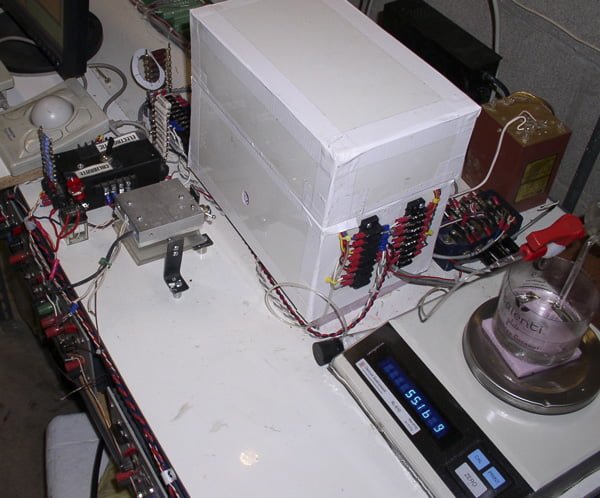
Fig. 9 from Report #5. Overall view of the calorimeter showing the position of a laser. A laser is positioned to apply laser light to the cathode surface at various angles and locations. The laser can be focused to change the spot size on the target, heated to change its frequency, and rotated to change its polarization relative to the target. A second laser can also be used either together or independently. A hole through the back of the calorimeter allows insertion of a fiber optical cable to measure the frequency of the laser. The laser is not being used at the present time.

Fig. 9 from Report #5. Overall view of the calorimeter showing the position of a laser. A laser is positioned to apply laser light to the cathode surface at various angles and locations. The laser can be focused to change the spot size on the target, heated to change its frequency, and rotated to change its polarization relative to the target. A second laser can also be used either together or independently. A hole through the back of the calorimeter allows insertion of a fiber optical cable to measure the frequency of the laser. The laser is not being used at the present time.

Production of excess energy is once again claimed, but this time it is correlated with radiation being generated by the energy-producing process. This correlation is new and provides powerful evidence for the excess energy being real and being caused by a nuclear reaction.

As for the importance of radiation. I have gradually come to the conclusion that claims for excess energy can not be attributed to a nuclear process unless they are correlated with the products of a nuclear process. The correlation with helium production meets this requirement. However, these measurements are difficult and expensive. Detection of radiation also meets this reqirement. In this case, the measurement is easy and cheap. The only requirement is to actually use a sensitive detector within the apparatus. Radiation with the energy being detected can not be made by a chemical reaction. This is proof of a nuclear process. As for reproducibility, I have already reproduced the effect several times and intend to use the correlation to justify my claims for producing LENR.

The role of temperature was largely misinterpreted in the past. Production of power is controlled by the ambient temperature, not by using pulses, although pulses will have an effect because they change the average ambient temperature. This realization has profound importance to any proposed explanation.

The composition of the PdD is not the most important variable in determining whether excess power will be produced. This study shows that temperature is one of the most important variables, which according to my theory affects the rate at which the D can diffuse to the NAE where the nuclear reaction takes place.

Of course, the NAE must be first created before any excess power will be produced regardless of the temperature. Temperature alone does not create the NAE nor does the composition alone create the NAE.

The ultimate challenge is to discover exactly what does cause the NAE to form. That is the goal of this study.

PROGRESS-REPORT-5 (20Mb) (corrected)

See also:

Progress Report #5

Progress Report #4

Progress Report #3

Progress Report #2

Progress Report #1

09.6.15

Interview with Peter Gluck

Edmund Storms from the interview with Peter Gluck of Ego-Out.

Edmund-StormsLENR has two aspects, each of which has to be considered separately.

The first question is where in the material does the nuclear reaction take place. In other words, were is the nuclear active environment (NAE) located?

The LENR reaction CAN NOT take place in the normal lattice structure where it would be subjected to the well known laws that apply to such structures.

So the question becomes, “Where in space is the NAE located, such as near the surface, and what is unique about the NAE that separates it from the normal structure”?

Before the nature of the nuclear process can be discussed, a NAE must be identified and its existence must be agree to. Failure to do this has resulted in nothing but useless argument with no progress in understanding or causing the phenomenon.

I propose the only place able to support such a nuclear reaction while not being subjected to the known chemical requirements are cracks consisting of two surfaces with a critical gap between them.

Once the characteristics of the NAE are identified, a mechanism can be proposed to operate in this NAE with characteristics compatible with this environment. Attempts to propose a mechanism without identifying the NAE are doomed to failure.

Without knowing the NAE, we are unable to test the characteristics of the nuclear mechanism to see if it is compatible with the material and we are unable to know how to create a potentially active material.

This requirement is so basic, further discussion is pointless unless agreement is achieved.

This is not a normal physics problem where any idea can be made plausible simply by making a few assumptions. The nature of the chemical environment prevents many assumptions. We are proposing to cause a nuclear reaction in ordinary material where none has been seen in spite of enormous effort and none is expected based on well understood theory.

A significant change in the material must first take place. This change must be consistent with the known laws of chemistry. Only the creation of cracks meets this requirement.

Once the NAE is identified, the characteristics of the nuclear reaction must be consistent with what is known. Simply proposing behavior based on general physics concepts is useless. For example, the role of perturbed angular correlations, which you suggest, must be considered in the context of the entire proposed reaction. The question means nothing in isolation.

Like many proposed mechanisms, the idea cannot be tested because it has no clear relationship to the known behavior of LENR or to the variables known to affect the phenomenon.

This is not a guessing game. We now have a large collection of behavior all models most explain. Why not start by considering models that are consistent with this information?

| Posted in Interview | Comments Off on Interview with Peter Gluck