Storms on The Space Show
Edmund Storms was the guest on the Space Show Tuesday March 15. The hour-long discussion with live call-in question and answer is here:
http://www.thespaceshow.com/show/15-mar-2016/broadcast-2666-dr.-edmund-storms
We welcomed back to the show Dr. Edmund Storms to discuss updates LENR R&D. During the first segment of our 62 minute discussion, Dr. Storms started us off with a brief historical overview of the Low Energy Nuclear Reaction -cold fusion energy research and development efforts. We discussed the use of the term cold fusion as compared to LENR, the work of Andrea Rossi and his E-Cat LENR generator, and the need for secrecy given the patent laws applicable to LENR designs and products.
In addition, Dr. Storms talked at length about the various chemical reactions that were being studied to produce LENR fusion, explaining why the experiments were challenging due to the difficulty in their being repeatable and dependable. He explained the different approaches being used and the “secret” seemingly known only to Rossi regarding his E-Cat device. During this discussion, Dr. Storms talked extensively about nuclear reactions, fuel, hydrogen isotopes, light hydrogen, nickel, and palladium.
Later in the segment, Dr. Storms was asked if the research for LENR was organized and centralized or decentralized. Our guest said the research was very dispersed and decentralized. Much of it was actually taking place in small private labs. He talked about research funding needs which could range from about a million dollars for a small lab to tens of millions of dollars for a large scale multi-lab research effort. Since he was making potential “save the world” type claims for this type of energy, I asked him about other energy forms discussed on The Space Show that make the same type of “save the world “claims. Don’t miss what Dr. Storm had to say in response to my question.
John in Ft. Worth called to talk about the original Pons and Fleishman cold fusion experiments. In responding, Dr. Storms introduced us to the concept of Nanoracks. Dr. Storms believes LENR has something to do with Nanoracks which he explained in detail with John and in the balance of the first segment.
BJohn asked about LENR applications for spaceflight. Sandra asked about the size of LENR generators and if they would be individual or industrial in scope. Don’t miss the vision Dr. Storm explained to us regarding LENR usage, starting at the industrial scale but working toward individual usage. He talked about the problems & challenges in accomplishing the transition from industrial to personal.
In the second segment, Dr. Storms was asked about the methodology and game plan for developing and bringing to commercial operation LENER. Our guest talked at length about the need for a varied multi-discipline set of studies including nuclear physics and chemistry. He explained why this was an unlikely academic mix. Also during this segment, he stressed over and over again that there were no academic classes in LENR anywhere plus there were no text books on the subject. In fact, John from Ft. Worth even inquired as to why so much of conventional science was opposed to LENR.
Later in the segment, I asked for Dr. Storm’s plan to accelerate LENR R&D. He suggested putting the effort and money into the national labs research programs which a more sympathetic to LENR research. He said the work from the labs would be highly credible and would then be useful in helping to start academic programs facilitating the study of the subject. As the program was nearing its end, Larry asked about crowd funding programs to support this research. Don’t miss Dr. Storm’s concluding comments.
Please post your comments/questions in the comments section for this archived program on The Space Show website. You can reach Dr. Edmund Storms through me at drspace@thespaceshow.com.
What does theory do and how does it need to be tested?
For this discussion, I use the word “theory” to describe any attempt to explain using unifying concepts, regardless of the detail or the certainty being applied or expected.
All phenomenon in Nature are complex and do not have a single behavior. Some phenomenon have a single and obvious characteristic, such as gravity. But a full understanding requires more information than only a falling apple provides. A theory attempts to bring all the behaviors together into a single unifying understanding.
Sometimes, the behavior complex is large and involves many kinds of behaviors, such as is found for LENR. This phenomenon involves chemistry, nuclear physics, quantum physics, nano-technology, heat measurements, radiation measurements, and psychology. Each behavior appears to be isolated from every other behavior while being very unreliable in its occurrence. A different set of behaviors are even observed when different conditions are used. As result, a person has difficulty in knowing how many independent phenomenon are operating.
Without a unifying explanation, these behaviors make no sense, they can not be produced with reliable expectation, and amplification of the effect becomes impossible. We are forced to explore the effect at random, by trial and error, without any expectation of success.
This limitation can be greatly reduced when an effort is made to unify all the separate behaviors. Success requires the correct identification of the behaviors without introducing too much arbitrary imagination. The explanation must also be consistent as much as possible with behavior already accepted in chemistry and physics.
The best theory takes the greatest number of behaviors into account.
Unfortunately, we are presently overwhelmed by theories based on small subsets of the behavior complex.
The psychology of theory is also important. Some people seem to think that theory supports a claim, a conclusion, or a reveals something new about Nature. It does not. Theory is ONLY a tool used to connect a collection of behaviors so that the unifying characteristics can be revealed.
Theory can be neither proven or disproven. Only a logical relationship can be proven or disproven, but this kind of relationship is not a theory of natural behavior. Mixing these two kinds of explanations creates much confusion, especially in the minds of mathematicians who think their equations actually are an expression of the real Nature.
A theory of natural behavior simply relates a collection of behaviors in order to predict future behavior under a wide variety of conditions. For example, the laws of thermodynamics allow the behavior of chemical systems to be predicted when a wide range of conditions are used. The theory does not reveal how how or why these behaviors occur, except perhaps as result of using imagination.
Quantum theory attempts to answer such questions, but again much imagination must be used. The part of any theory based only on imagination is subject to change as more understanding based on behavior is achieved. Of course, the part of theory based on behavior, rather than imagination, remains unchanged. The connection between these two different aspects of theory remain confusing to many people, even to scientists.
To state another way, theory proves nothing about Nature and is subject to change without notice as the part based on imagination is modified. Nevertheless, the human mind must have an explanation regardless of how effective it might be in describing Nature. Any crazy idea will serve as long as it attempts to satisfy this craving. That is why so many theories are applied to LENR. LENR is a theory vacuum that must be filled. Pretending this need does not exist or is not important is pointless because it is basic to human nature.
Nevertheless, this does not mean all theories need to be taken seriously. Eventually, someone will put the pieces together in the correct way and the theory will become part of conventional understanding. The sooner this happens, the sooner the effect will be accepted by conventional science.

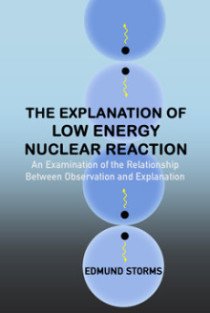
New graphic from updated version of The Explanation of Low Energy Nuclear Reaction depicting resonating hydrogen nuclei upon approach
In my case, I have attempted to unify as many behaviors as possible while identifying all the behaviors and citing the sources. I also attempted to show the deficiencies of other theories, which need to be filled rather than stubbornly insisting on deficient ideas.
Understanding the logical connections in my theory will reveal a total structure that connects many behaviors. Appropriate testing to keep, modify, or discard any ideas can then be used to refine the model.
| Posted in Science | Comments Off on What does theory do and how does it need to be tested?


| Posted in Interview | Comments Off on Storms on The Space Show