LENR behaviors that theory must explain
The many discussions of theory have encouraged me to summarize what is known about LENR having relevance to theory, and what a theory requires to explain.
A theory in conflict with any one of these essential requirements, I suggest, is not worth discussing. On the other hand, many details about each of the requirements need to be ignored until more information is obtained. Nevertheless, the basic requirements can be used to eliminate many ideas and reduce the discussion to a few possibilities.
For those who believe theory is not important or useful, I would like to point out that we presently have theories being used to explain behavior and to design experiments. If these theories are wrong, the conclusions being reported will be wrong. Agreeing on the basic characteristics of LENR would help prevent such mistakes.
LENR has a few basic and well established behaviors and many unknown features. We can debate the unknowns, but the well known behaviors must be acknowledged by any effective explanation.
Of course, imagination can provide all kinds of exceptions to any condition, but an effective search best focuses on the more plausible and more likely possibilities.
The well known LENR behaviors include:
1. LENR is initiated only with great difficulty. Many materials have been subjected to a wide range of conditions without LENR being produced.
2. Once a material is “activated” the LENR effect is robust and sustained with a possible rate in excess of 10^11 events/sec.
3. Helium, tritium, and a variety of transmutation products are formed.
4. Each of these nuclear products are found produced in the surface region when the location can be determined.
5. Helium production is the source of most observed heat energy.
6. Very little energetic radiation is detected outside the apparatus.
7. Because LENR takes place in a chemical structure surround by normal atoms, the mechanism causing the nuclear reaction must be consistent with this environment.
Normally, any mechanism able to initiate a nuclear reaction will also cause significant chemical changes in the surrounding material. Such changes are not observed when LENR occurs.
1. The behavior identified as #1 implies that a rare and novel condition must form in the material in order for the LENR process to occur. I call this region the nuclear active environment (NAE). This region is not present in most materials and can not be easily created.
This characteristic eliminates vacancies of any type, dislocations of any kind, impurities of any kind, and large cracks because each of these features is normally present in common materials.
2. The characteristics listed in #2 show that the NAE is stable once formed and can be present in significant concentration. The NAE is not the result of a minor impurity or an occasional flaw in the material.
3. Helium and tritium formation can be attributed to reactions between isotopes of hydrogen but transmutation is difficult to explain. The explanation of transmutation must account for two types, one that adds helium to a nucleus without fragmentation and another type that results in fragmentation of the target after hydrogen is added.
4. The nuclear products are found associated only with the surface region. Consequently, the NAE is not expected to form in the bulk material.
5. Most of the heat energy results from He4 formation when deuterium is used. An effective theory must explain how helium is formed while producing the amount of energy expected to result from D+D fusion.
6. The huge mass-energy released by a nuclear reaction must be communicated to the surrounding material as heat energy. This process must not destroy the NAE or create significant energetic radiation. Consequently, a narrow range is placed on the rate at which energy is released and the type of the energy release process.
7. Creation of the NAE and the nuclear process must be compatible with the chemical conditions known to be associated with the material in which LENR takes place.
Are there additions or clarifications?
Can these requirements be used to eliminate the bad theories?
11.4.15On tritium production in LENR
Tritium is the best documented demonstration of the LENR process. Here is a histogram showing the number of measurements that related tritium to neutron production.
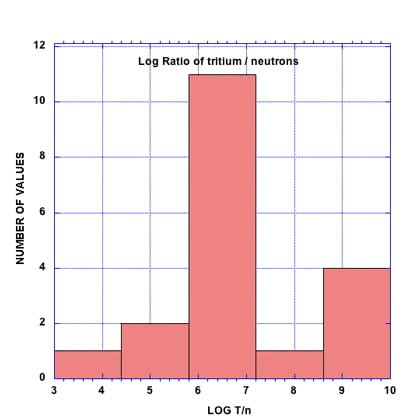
Number of experiments that related tritium to neutron production.
Many more measurements of tritium are available that did not attempt to measure the neutron flux. Tritium can be detected without any doubt and it can only result from a novel nuclear process having no conventional explanation.
The reason for its low production rate can be explained. As I have proposed, tritium results from fusion of d-e-p. An effective rate requires an equal amount of d and p in the NAE. Unfortunately, most studies when tritium is detected used pure D2O containing very little p. Consequently, finding very little tritium is to be expected. One study shows that the amount of tritium produced is sensitive to the d/p ratio, as this fusion process would predict.
Production of energy is also low when tritium forms because only 6 MeV/event is produced. Addition of H2O to D2O reduces the amount of power. The exact amount of reduction still needs further study.
Very few ways are available to produce tritium without neutrons being produced or being used. The fact that tritium is found without neutron involvement provides a window into the LENR process not available when only helium is considered.
Helium has provided an explanation for the energy but its presence gives limited information about the mechanism. Obviously, two D must fuse to produce He. We are required to speculate about how this process might take place.
To form tritium from d and p, the only possible reactants present when LENR occurs, an electron must be added to the d+p fusion process. This addition gives insight into how the fusion process might take place.
If we assume, LENR involves the same mechanism regardless of the isotopes of hydrogen present, we obtain the process I have proposed. This process predicts the source of energy using Ni-H2, the spectrum of isotopes produced by the two transmutation reactions, and where to look for additional confirmation.
10.3.15Conclusion: Key to understanding FPE is temperature
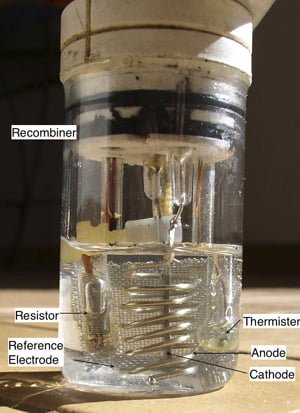 The Progress Reports have revealed some important behaviors having a relationship to attempts at replication and to the various proposed theories. Its time to put these behaviors in context and suggest some conclusions.
If you are tempted to speculate on your own, please do read the reports first and make yourself knowledgeable about what has been observed in other studies published over the last 26 years. We now have enough information, when considered in its totality, to arrive at some very firm conclusions.
Progress will be made only when this understanding is accepted and used as a guide to support additional understanding.
As anyone who is familiar with the many observations will understand; the conclusions noted below are totally consistent with past observed behavior. The only conflict is with the past conclusions. Many of these past conclusions are now shown to be wrong.
1. The LENR process is not initiated when a sample of Pd is initially loaded to high composition. Additional treatment is required to cause the LENR process to start. Once this additional treatment is successful, LENR will take place over a very wide range of deuterium concentration, even after all D is removed and the sample is again reacted with D.
2. Only certain batches of Pd can be activated. One of the requirements for successful activation is lack of significant excess volume formation when the Pd is reacted with D.
3. Excess power produced by an activated sample is very reproducible once it is initiated as long as the surface is not removed. This behavior is consistent with the surface being the location of the nuclear reaction based on the behavior of helium release.
4. Once the LENR process starts, the amount of current applied as electrolytic current has no effect on the amount of excess power produced. Only the temperature of the active surface has any effect on excess power production, with higher temperatures producing greater excess power. We can assume that once a sample is activated, simply exposing it to D2 gas and heating it would cause excess power production. In other words once the sample of Pd is activated, use of electrolysis is no longer necessary.
5. The activation energy for excess power production based on the temperature effect is similar to the value for the activation energy for diffusion of D in PdD. We can assume excess power production is controlled by how fast the D can diffuse from the surrounding lattice to the NAE where the nuclear reaction occurs.
6. So called life-after-death will result in eventual destruction of the sample if the temperature is not controlled, as some people have observed. In other words, the system suffers from positive feedback as Rossi has also experienced using the Ni-H2 system. This positive feed back is generally not observed because the amount of power produced relative to the rate at which it can be lost is small.
7. Once the role of electrolytic current is understood, the F-P method can be seen to have the same basic behavior as all methods found to initiate LENR, including the Ni-H2 system. In other words, no reasons exists based on observed behavior to consider the Pd-D2 system different from the Ni-H2 system. Only the reacting isotopes are different which naturally would produce different nuclear products.
All of behaviors and conclusions resulting from this study are consistent with the Nano-crack theory I proposed. Most other proposed theories are not consistent with all the observations and conclusions. These conflicts need to be resolved for any progress to be made.
See also:
| Posted in Science | 10 Comments »
Progress Report #6
This report extends the insights described in Report #5 and shows that several common conclusions about LENR are wrong. These errors have handicapped efforts to achieve reproducibility and have lead several theories in the wrong direction.
PROGRESS-REPORT-6 Additional behavior of pure PdD (1.3Mb)
Temperature plays a significant role in affecting the amount of power produced by LENR. The activation energy for power production is very similar to the activation energy for diffusion of D in PdD. This behavior is consistent with my theory in which temperature is described as helping D reach the NAE by diffusion through the surrounding lattice.
Comments are welcome.
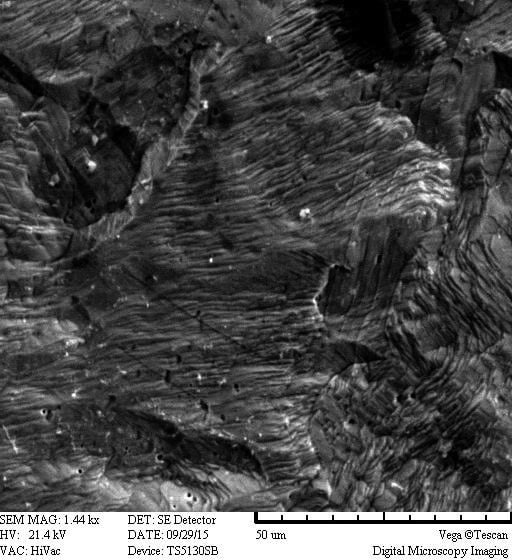
Figure 9 from Progress Report #6 showing surface of the Pd cathode after the study.
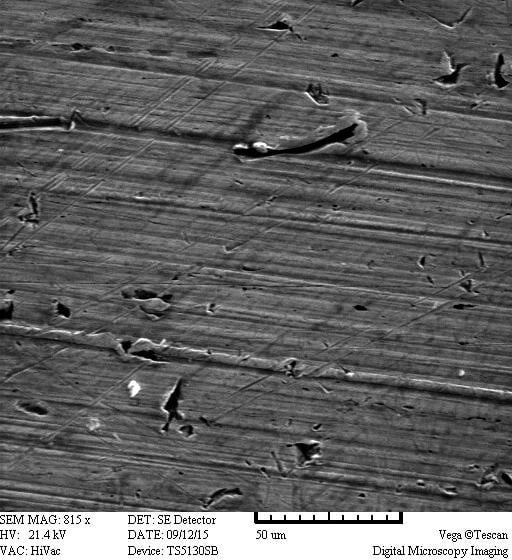
Figure 10 from Progress Report #6 shows surface of Pd before the study.
Read more from PROGRESS-REPORT-6 (1.3Mb)
See also:
09.14.15Progress Report #5
Here is the latest progress report. Shown are some important behaviors that have been misinterpreted in the past, so a careful reading would be useful. This report will appear with the other Reports on www.LENRexplained.com. Because these are quickly written informal reports, some typos and other errors are to be expected. Comments and suggestions are welcome.
PROGRESS-REPORT-5 (20Mb) (corrected)
This study is an example of having available an apparatus that can detect new behaviors only because such behaviors are expected. We see only what we are permitted to see by the apparatus. Consequently, the design of the apparatus is basic to understanding LENR. In this case, the design was influenced by the behaviors predicted by my theory.
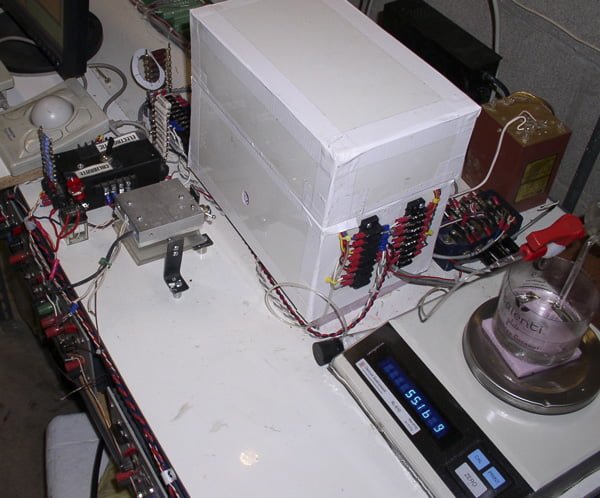
Fig. 9 from Report #5. Overall view of the calorimeter showing the position of a laser. A laser is positioned to apply laser light to the cathode surface at various angles and locations. The laser can be focused to change the spot size on the target, heated to change its frequency, and rotated to change its polarization relative to the target. A second laser can also be used either together or independently. A hole through the back of the calorimeter allows insertion of a fiber optical cable to measure the frequency of the laser. The laser is not being used at the present time.
Production of excess energy is once again claimed, but this time it is correlated with radiation being generated by the energy-producing process. This correlation is new and provides powerful evidence for the excess energy being real and being caused by a nuclear reaction.
As for the importance of radiation. I have gradually come to the conclusion that claims for excess energy can not be attributed to a nuclear process unless they are correlated with the products of a nuclear process. The correlation with helium production meets this requirement. However, these measurements are difficult and expensive. Detection of radiation also meets this reqirement. In this case, the measurement is easy and cheap. The only requirement is to actually use a sensitive detector within the apparatus. Radiation with the energy being detected can not be made by a chemical reaction. This is proof of a nuclear process. As for reproducibility, I have already reproduced the effect several times and intend to use the correlation to justify my claims for producing LENR.
The role of temperature was largely misinterpreted in the past. Production of power is controlled by the ambient temperature, not by using pulses, although pulses will have an effect because they change the average ambient temperature. This realization has profound importance to any proposed explanation.
The composition of the PdD is not the most important variable in determining whether excess power will be produced. This study shows that temperature is one of the most important variables, which according to my theory affects the rate at which the D can diffuse to the NAE where the nuclear reaction takes place.
Of course, the NAE must be first created before any excess power will be produced regardless of the temperature. Temperature alone does not create the NAE nor does the composition alone create the NAE.
The ultimate challenge is to discover exactly what does cause the NAE to form. That is the goal of this study.
PROGRESS-REPORT-5 (20Mb) (corrected)
See also:


| Posted in Science | 37 Comments »