Interview with Peter Gluck
Edmund Storms from the interview with Peter Gluck of Ego-Out.
 LENR has two aspects, each of which has to be considered separately.
The first question is where in the material does the nuclear reaction take place. In other words, were is the nuclear active environment (NAE) located?
The LENR reaction CAN NOT take place in the normal lattice structure where it would be subjected to the well known laws that apply to such structures.
So the question becomes, “Where in space is the NAE located, such as near the surface, and what is unique about the NAE that separates it from the normal structure”?
Before the nature of the nuclear process can be discussed, a NAE must be identified and its existence must be agree to. Failure to do this has resulted in nothing but useless argument with no progress in understanding or causing the phenomenon.
I propose the only place able to support such a nuclear reaction while not being subjected to the known chemical requirements are cracks consisting of two surfaces with a critical gap between them.
Once the characteristics of the NAE are identified, a mechanism can be proposed to operate in this NAE with characteristics compatible with this environment. Attempts to propose a mechanism without identifying the NAE are doomed to failure.
Without knowing the NAE, we are unable to test the characteristics of the nuclear mechanism to see if it is compatible with the material and we are unable to know how to create a potentially active material.
This requirement is so basic, further discussion is pointless unless agreement is achieved.
This is not a normal physics problem where any idea can be made plausible simply by making a few assumptions. The nature of the chemical environment prevents many assumptions. We are proposing to cause a nuclear reaction in ordinary material where none has been seen in spite of enormous effort and none is expected based on well understood theory.
A significant change in the material must first take place. This change must be consistent with the known laws of chemistry. Only the creation of cracks meets this requirement.
Once the NAE is identified, the characteristics of the nuclear reaction must be consistent with what is known. Simply proposing behavior based on general physics concepts is useless. For example, the role of perturbed angular correlations, which you suggest, must be considered in the context of the entire proposed reaction. The question means nothing in isolation.
Like many proposed mechanisms, the idea cannot be tested because it has no clear relationship to the known behavior of LENR or to the variables known to affect the phenomenon.
This is not a guessing game. We now have a large collection of behavior all models most explain. Why not start by considering models that are consistent with this information?
Progress Report #4
PROGRESS-REPORT-4 Effect of Important Variables
INTRODUCTION
The previous Progress Reports can be read at www.LENRexplained.com. The various novel features of the calorimeter are explored in this Progress Report.
These features included measurement of OCV, loading behavior, the effect of temperature on the various behaviors, and the behavior of volume expansion resulting from repeated loading and deloading.
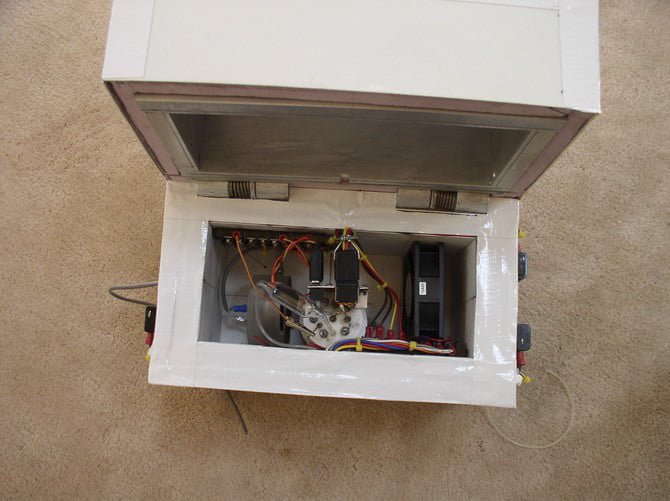
From Progress Report #1, a view inside the calorimeter showing the components. The cell is in the
center, the GM detector is on the left, and the fan is on the right.
A number of Pd-Ag compositions have been made and subjected to treatments and measurements considered important to this study. These treatments include measurement of the sample volume during various stages in its treatment and subjecting the sample to various methods to improve its reaction with hydrogen.
The relationship between each of these variables and production of excess energy will be established in order to improve the reproducibility of producing this extra energy. The initial results from the study of each of these variables are described and discussed below.
RESULTS
1. Expansion behavior
As described previously(1, 2), the guide used to design this research identifies expansion of the material as result of reaction with hydrogen as being an important variable for excess power production. Because the excess power requires deuterium to be present, the sample must first react with deuterium. This reaction causes the material to expand and change shape by more than would be expected based on the known increase in lattice parameter of the beta phase. This additional volume is retained when the hydrogen isotope is removed. This shape change is proposed to produce uneven stress and formation of cracks, which allow a nuclear process to take place in the gaps when the gap is exactly right. Consequently, the amount of hydrogen able to react and the resulting uneven expansion is important to know and control.
The expansion is measured using micrometers after various treatments have been applied. An example of this behavior using pure palladium is summarized in Table 1. ….
Continue to read PROGRESS-REPORT-4
1. E. K. Storms, The explanation of low energy nuclear reaction. (Infinite Energy Press, Concord, NH, 2014), pp. 365 pages, (updated e-version available at Amazon.com).
2. E. K. Storms, A Theory of LENR Based on Crack Formation. Infinite Energy 19, 24-27 (2013).
See also:
08.24.15Progress Report #3
This study involves creation of various alloys, their activation for reaction with deuterium in an electrolyte cell, and measurement of any energy resulting from LENR. The process involves variables important to success, which are described in this series of progress reports. Copies of Reports #1 and #2 can be accessed at www.LENRexplained.com, where subsequent reports will be found.
Progress report #1 describes the construction of the calorimeter being used in this study and the approach used to find nuclear active material. Progress report #2 describes the initial calibration and the expected errors. This report summarizes some problems and solutions discovered during the initial tests.
1. Calorimeter drift: The calibration of the calorimeter has been found to have changed, probably because the epoxy used to attach the TEC to the aluminum box has cured and now has a slightly different thermal conductivity. This change resulted in what appeared to be excess power being generated by the samples being studied. A routine test of the calorimeter using an inert platinum cathode revealed this change and the resulting error.
This test also revealed an error caused by the rapid variations in cell voltage caused by bubble formation that is not present when a resistor is used to apply energy to the calorimeter. This error was eliminated by inserting a 10,000 mfd capacitor in the voltage circuit to smooth the variations and by increasing the number of measurements that are averaged. These changes produce agreement between the power applied to the electrolytic cell and power applied to a resistor to within 0.02 watt over the range of applied power (0-34 watts) used in this study.
The resulting calibration values are plotted in Fig. 1, to which a quadratic equation is fit.

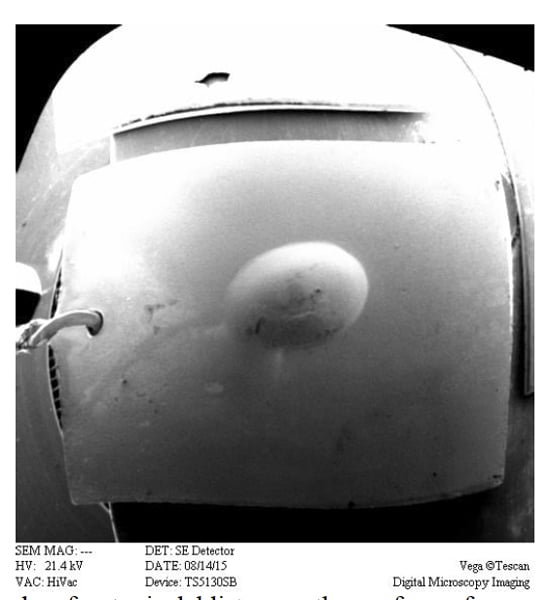
2. Preparation of samples: The samples are prepared by melting together Pd and Ag using a flame. The initial flame used LP gas and oxygen, which placed significant carbon in the material and caused many blisters to form on the surface after reaction with deuterium. These blisters interfere with making an accurate measurement of thickness.
Fig. 2 shows a large blister on a typical sample. Many of the blisters were too small to detect by eye. In addition, the flame was not hot enough to fully melt the entire sample, leaving an unmelted region where the sample contacted the graphite sheet on which it rested. Consequently, a uniform composition of silver was difficult to achieve.
Read more in PROGRESS REPORT #3
See also:
08.13.15Progress Report #2
This report describes how a Seebeck calorimeter is calibrated in order to measure the amount of excess power produced by a cathode in an electrolytic cell contained in the calorimeter and the expected uncertainty in this value.
PROGRESS-REPORT-2 (3.5Mb)
A Seebeck calorimeter uses thermoelectric converters (TEC) to create a voltage proportional to the rate at which heat energy leaves the calorimeter. The present design consists of a water-cooled aluminum box with TEC covering the inside of each surface.
Consequently, the amount of heat energy leaving the box is measured regardless of where this loss takes place. A calibration using a known source of heat energy is required to calibrate the device.
Two different methods are used to apply known heat energy, with several variations involving the electrolytic cell or resistors external to the cell. Electric power can be supplied to the electrolytic cell containing a platinum cathode, which is presumed to produce no excess energy. Or electric power can be applied to a glass covered internal resistor located in the electrolyte, as can be seen in Fig. 1.
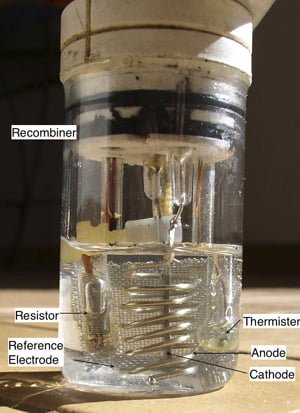 FIGURE 1. Pyrex electrolytic cell. The electrolytic cell consists of a cathode and anode and the internal resistor consists of a coil of nichrom wire immersed in oil contained in a thin wall Pyrex tube.
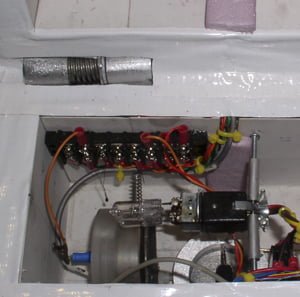 FIGURE 2. Picture of the two small quartz light bulbs used for calibration. One is connected to the circuit providing power to the anode and cathode and the other is connected to the circuit supplying power to the resistor contained in the Pyrex cell, which is removed for this test.
Read more in PROGRESS-REPORT-2 (3.5Mb)
See also:
08.3.15Progress Report #1: New calorimeter design will test nanocrack parameters
I’m starting a relatively rare kind of project for this field. I have designed and built a Seebeck type calorimeter for the purpose of testing my theory.
First, an attempt will be made to achieve reproducible heat production by applying my theory to the treatment of palladium-based samples. The treatment will be designed to create nano-sized cracks in which I propose the LENR process takes place. Once an active sample is obtained, it will be studied as the cathode in an electrolytic cell placed in a calorimeter.
A variety of behaviors will be explored including loading behavior, emission of photon radiation, effect of temperature on energy production, and the effect of laser light. The cathode can be rotated with respect to the GM detector and the laser to determine whether the angle of emitted or applied radiation relative to the surface is important.
View inside the calorimeter showing the components. The cell is in the center, the GM detector is on the left, and the fan is on the right.
Based on my theory, I predict that all occasions when LENR is observed, the same mechanism is operating. Therefore, information obtained using PdD would apply to all other materials and isotopes of hydrogen found to produce the same phenomenon.
The electrolytic method is chosen for this study because it is the most explored and best understood of the various methods known to initiate LENR. Nevertheless, the calorimeter would permit use of any other methods for initiating the effect, but on a small scale. The size of the sample is not important as long as accuracy of the measurement is sufficient large. The calorimeter used here is designed to have very high accuracy, which will be demonstrated in due course.
The following predictions will be explored:
1. The rate of the LENR reaction is regulated by the availability of hydrogen to the NAE, with a significant rate being possible at low hydrogen isotope compositions when the amount of NAE is sufficiently large.
2. The rate of the LENR reaction is affected by temperature only as result of how it effects the diffusion rate of hydrogen through the material.
3. Photon radiation will be emitted when LENR occurs, with a particular relationship between the angle between the surface and the detector.
4. The rate of the LENR reaction already underway can be increased by application of laser light, with an increased reaction rate as the energy of the light is increased. An enhanced effect can be expected when the frequency matches the dimension of an active crack.
5. Generation of excess energy does not require extended electrolysis when the NAE is created in advance.
This report describes the construction and physical layout of the calorimeter:

Top view of calorimeter assembly
The next report will describe the calibration and the general behavior of the tool, followed by studies of various behaviors of PdD.
See also: